



Electric Metal sealing butterfly valve

Structure principle
Butterfly valve (also known as flip valve) is a regulating valve with a circular valve disc or disc as the closing part. It is mainly composed of a valve body, a valve stem, a butterfly plate and a sealing ring. The valve body is cylindrical, with short axial length and built-in butterfly plate. The butterfly plate of the butterfly valve is installed in the diameter direction of the pipe. In the cylindrical channel of the butterfly valve body, the disc-shaped butterfly plate rotates around the axis, and the rotation angle is between 0° and 90°. When it rotates to 90°, the valve is fully open.

The butterfly valve has a simple structure, small size and light weight, and is composed of only a few parts. Moreover, it only needs to be rotated 90° to quickly open and close, which is simple to operate. At the same time, the valve has good fluid control characteristics. When the butterfly valve is in the fully open position, the thickness of the butterfly plate is the only resistance when the medium flows through the valve body. Therefore, the pressure drop generated by the valve is very small, so it has good flow control characteristics. Butterfly valves have two sealing types: elastic seal and metal seal. For elastic sealing valves, the sealing ring can be embedded in the valve body or attached to the periphery of the butterfly plate.
Butterfly valves with metal seals generally have a longer life than elastically sealed butterfly valves, but it is difficult to achieve complete sealing. Metal-sealed butterfly valves can adapt to higher operating temperatures, while elastic-sealed butterfly valves have the disadvantage of being limited by temperature.
If a butterfly valve is required to be used as a flow control, the main thing is to select the correct size and type of valve. The structural principle of butterfly valve is especially suitable for making large diameter valves. Butterfly valves are not only widely used in general industries such as petroleum, gas, chemical industry, and water treatment, but are also used in the cooling water system of thermal power stations.
Commonly used butterfly valves include wafer butterfly valves and flange butterfly valves. Wafer-type butterfly valves use studs to connect the valve between two pipe flanges. Flange-type butterfly valves have flanges on the valve, and bolts are used to connect the flanges at both ends of the valve to the pipe flanges.
High pressure resistance
Thickened valve body, high hardness, strong toughness, high pressure resistance, strong pressure resistance and crack prevention ability

Turbine transmission, fast and labor-saving
General turbine head. The switch is more labor-saving, the valve body is thickened, the weight is heavier and safer
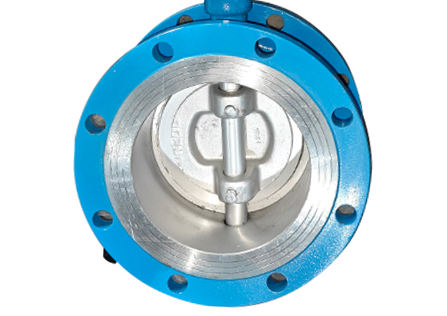
usage principle and installation instructions
The relationship between the opening of the butterfly valve and the flow rate basically changes in a linear proportion. If it is used to control flow, its flow characteristics are also closely related to the flow resistance of the piping. For example, if two pipelines are equipped with the same valve diameter and form, but the pipeline loss coefficient is different, the flow rate of the valve will be very different.
If the valve is in a state of large throttling amplitude, cavitation is prone to occur on the back of the valve plate, which may damage the valve. It is generally used outside 15°. When the butterfly valve is in the middle opening, the opening shape formed by the valve body and the front end of the butterfly plate is centered on the valve axis, and the two sides form different states. The front end of the butterfly plate on one side moves in the direction of the flow of water, and the front end of the butterfly plate on the other side moves in the direction of the water flow. Therefore, one side of the valve body and the valve plate form a nozzle-shaped opening, and the other side is similar to a throttle-shaped opening. The flow rate on the nozzle side is much faster than that on the throttling side, and negative pressure will be generated under the throttling side valve, often Rubber seals may come off.
The operating torque of a butterfly valve has different values due to different openings and valve opening and closing directions. For horizontal butterfly valves, especially large-diameter valves, the torque generated by the water depth and the head difference between the upper and lower valve shaft cannot be ignored. In addition, when an elbow is installed on the inlet side of the valve, bias flow will occur and the torque will increase. When the valve is at the intermediate opening, the operating mechanism needs to self-lock due to the effect of hydrodynamic torque.
Product features
Small size and light weight: both volume and weight are 1/3 of valve products;
Beautiful and generous: die-cast alloy shell. The appearance is fine and smooth and reduces electromagnetic interference;
Complete functions: switch type (i.e. passive contact type), proportional control type, and intelligent adjustment type;
Easy to use: No inspection required. Oil-free, rust-proof and waterproof, can be installed at any angle;
Multiple protections: electrical limit, mechanical limit, overheating protection, overload protection, de-temperature protection;
Various violations: 5 seconds, 8 seconds. 15 seconds, 30 seconds. 50 seconds, 100 seconds, etc.;
CNC adjustment: highly integrated intelligent modules, digital settings, digital tuning, highly accurate self-diagnosis, no need for positioners, automatic control, one machine with multiple functions;
Safety guarantee: Passed AC1500V withstand voltage test, H-class highly insulated motor to ensure body and production safety;
The matching is simple, using single-phase, three-phase, and DC power supplies. The external wiring is simple.
Performance features
1. This valve adopts a three-eccentric sealing structure, with almost no wear on the valve seat and butterfly plate, and has a tighter sealing function as it is closed.
2. The sealing ring is made of stainless steel, which has the dual advantages of metal hard sealing and elastic sealing. It has excellent sealing performance no matter under low or high temperature conditions, and has the characteristics of corrosion resistance and long service life.
3. The sealing surface of the butterfly plate is made of cobalt-based hard alloy surfacing. The sealing surface is corrosion-resistant and has a long service life.
4. This valve has a two-way sealing function. It is not restricted by the flow direction of the medium or affected by the spatial position during installation. It can be installed in any direction.
Structural features and uses
Metal seal butterfly valve series products are long-life, energy-saving butterfly valves. The products comply with the national standards JB/T8527-97 (metal seal butterfly valve), GB/T13927-92 (universal valve pressure test) standards and other related standards for valves. This product consists of valve body, butterfly plate, sealing ring, transmission mechanism and other main components. Its structure is designed using the three-dimensional eccentric principle, and a new processing technology compatible with elastic sealing and hard and soft multi-layer sealing enables the butterfly valve to reduce its torque force during operation, achieving labor-saving and energy-saving functions. This ensures the overall reliability of the butterfly valve in terms of corrosion resistance, high temperature resistance and wear resistance. This butterfly valve is suitable for use in food, medicine, petrochemical industry, power plants, steel plants, industrial environmental protection water treatment and high-rise buildings, as the best device to regulate flow and cut off fluids in water supply and drainage pipelines.
Company qualifications


Hot Tags: dn200 on-off valve actuator butterfly valve, China, manufacturers, suppliers, factory, buy, price, quotation, Motorized Control Butterfly Valve, Pneumatic Actuator Butterfly Valve, Electric Actuated Butterfly Valve, Motorized Butterfly Valve, Wafer Butterfly Valve, High Performance Butterfly Valve


