



Damper valve
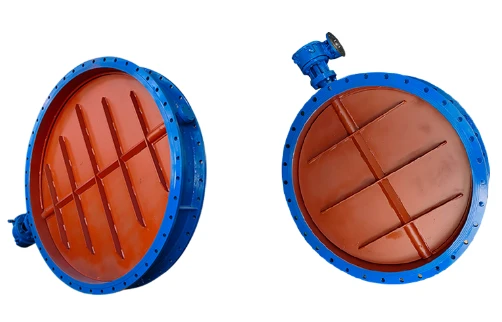
Instructions for use of Damper valve
The structural design of the damper valve should be combined with the working conditions of the valve.
1. Under the smelting conditions with high temperature and large dust content, the design of the damper valve can adopt a flat inclined plate structure. There is a gap between the butterfly plate and the valve body of this structure. The gap value depends on the valve caliber and process. The conditions of use are determined, and are generally controlled within 0.5% of its channel area, which can meet the installation of ventilation butterfly valves, temperature changes in working conditions, and melting process requirements.
2. Under acid-making working conditions with high temperature and low dust content, the damper valve can be designed with a vertical plate structure. The sealing surface of this structure is easy to process, and the sealing surface gap value is controlled within 0.2% of the channel area. The dimensional accuracy of the valve body and butterfly plate seal pair can meet the design requirements through mechanical processing.
3. For working conditions with high temperature, low pressure and strict sealing requirements, the damper valve is designed to adopt a lever-type planar structure. The sealing pair configuration and butterfly plate running trajectory can meet the process requirements of pipe network equipment with high sealing performance.
The main seal of the damper valve adopts different structures according to different working conditions, which is beneficial to valve production and working conditions. The shaft end structure design of the damper valve adopts an external support structure with excellent heat insulation and sealing effects, which can realize the function of sealing first and then supporting the two shaft ends of the valve, making it easy to adjust without causing shaft end jamming. When the direct-connected or crank connecting rod mechanism is connected to the transmission mechanism, the installation of a heat insulation sleeve can effectively distance the impact of the high temperature environment on the transmission device and ensure the normal operation of the valve. The valve body and butterfly plate of the large-diameter damper valve should be cast or welded according to the requirements of the working conditions. Both should be equipped with ribs. Reasonable process plans and materials should be selected to improve the rigidity of the product and prevent product deformation.
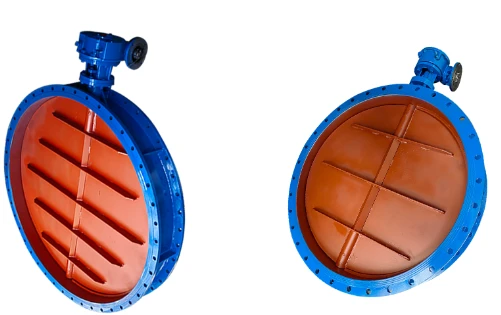
Working principle diagram of electric butterfly valve
According to different connection methods, electric butterfly valves can generally be divided into the most common electric wafer butterfly valves and electric flange butterfly valves. The sealing materials include soft seals (normal temperature and pressure) and hard seals (high temperature and high pressure). The working power supply usually includes: AC220V, AC380V, DC24V, the input signal includes 4~20mA 0~10v and other weak current signals. Finally, according to the control form, it is divided into on-off type and modulating type. The on-off type plays the role of switch; the modulating type is used to adjust the flow and can accurately It is also a relatively expensive valve to adjust the flow to a thousandth of a degree.

Structural principle of butterfly valve
Butterfly valve (also known as flap valve) is a regulating valve with a circular valve disc or disc as the closing part. It is mainly composed of a valve body, a valve stem, a butterfly plate and a sealing ring. The valve body is cylindrical, with short axial length and built-in butterfly plate. The butterfly plate of the butterfly valve is installed in the diameter direction of the pipe. In the cylindrical channel of the butterfly valve body, the disc-shaped butterfly plate rotates around the axis with a rotation angle between 0° and 90°. When it rotates to 90°, the valve is fully open.

Hot Tags: dn3000 flange wcb manual damper valve, China, manufacturers, suppliers, factory, buy, price, quotation


