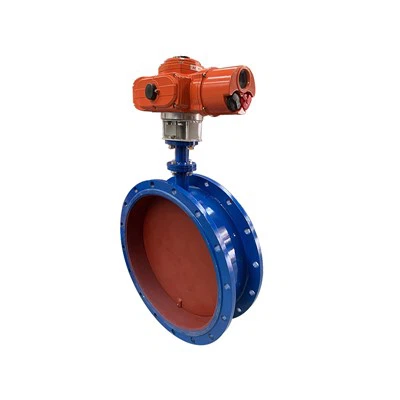


DN300 Butterfly Valve

Overview
Butterfly valve is a valve that uses a disc-type opening and closing part to rotate back and forth about 90° to open, close and adjust the fluid channel. Butterfly valves not only have simple structure, small size, light weight, low material consumption, small installation size, small driving torque, easy and rapid operation, but also have good flow adjustment function and closing sealing characteristics. One of the fastest growing valve varieties. Especially in industrially developed countries such as the United States, Japan, Germany, France, and Italy, butterfly valves are widely used. The varieties and quantities used are still expanding, and they are moving towards high temperature, high pressure, large diameter, high sealing, long life, It has excellent regulating characteristics and multi-functional development in one valve. Its reliability and other performance indicators have reached a high level, and it has partially replaced globe valves, gate valves and ball valves. With the advancement of butterfly valve technology, butterfly valves will become the dominant valve form in a foreseeable short time, especially in the fields of medium and low pressure applications of large and medium-sized valves.
product composition

The principle of use and installation of butterfly valve
The relationship between the opening of the butterfly valve and the flow rate basically changes in a linear proportion. If it is used to control flow, its flow characteristics are also closely related to the flow resistance of the piping. For example, if two pipelines are equipped with the same valve diameter and form, but the pipeline loss coefficient is different, the flow rate of the valve will be very different.
If the valve is in a state of large throttling amplitude, cavitation is prone to occur on the back of the valve plate, which may damage the valve. It is generally used outside 15°.
When the butterfly valve is in the middle opening, the opening shape formed by the valve body and the front end of the butterfly plate is centered on the valve axis, and the two sides form different states. The front end of the butterfly plate on one side moves in the direction of the flow of water, and the front end of the butterfly plate on the other side moves in the direction of the water flow. Therefore, one side of the valve body and the valve plate form a nozzle-shaped opening, and the other side is similar to a throttle-shaped opening. The flow rate on the nozzle side is much faster than that on the throttling side, and negative pressure will be generated under the throttling side valve, often Rubber seals may come off.
The operating torque of a butterfly valve has different values due to different openings and valve opening and closing directions. For horizontal butterfly valves, especially large-diameter valves, the torque generated by the water depth and the head difference between the upper and lower valve shaft cannot be ignored. In addition, when an elbow is installed on the inlet side of the valve, bias flow will occur and the torque will increase. When the valve is at the intermediate opening, the operating mechanism needs to self-lock due to the effect of hydrodynamic torque.
Instructions for use of damper valve
The structural design of the ventilation butterfly valve should be combined with the working conditions of the valve.
1. Under the smelting conditions with high temperature and large dust content, the design of the ventilation butterfly valve can adopt a flat inclined plate structure. There is a gap between the butterfly plate and the valve body of this structure. The gap value depends on the valve caliber and process. The conditions of use are determined, and are generally controlled within 0.5% of its channel area, which can meet the installation of ventilation butterfly valves, temperature changes in working conditions, and melting process requirements.
2. Under acid-making working conditions with high temperature and low dust content, the ventilation butterfly valve can be designed with a vertical plate structure. The sealing surface of this structure is easy to process, and the sealing surface gap value is controlled within 0.2% of the channel area. The dimensional accuracy of the valve body and butterfly plate seal pair can meet the design requirements through mechanical processing.
3. For working conditions with high temperature, low pressure and strict sealing requirements, the ventilation butterfly valve is designed to adopt a lever-type planar structure. The sealing pair configuration and butterfly plate running trajectory can meet the process requirements of pipe network equipment with high sealing performance. The main seal of the ventilation butterfly valve adopts different structures according to different working conditions, which is beneficial to valve production and working conditions. The shaft end structure design of the ventilation butterfly valve adopts an external support structure with excellent heat insulation and sealing effects, which can realize the function of sealing first and then supporting the two shaft ends of the valve, making it easy to adjust without causing shaft end jamming. When the direct-connected or crank connecting rod mechanism is connected to the transmission mechanism, the installation of a heat insulation sleeve can effectively distance the impact of the high temperature environment on the transmission device and ensure the normal operation of the valve. The valve body and butterfly plate of the large-diameter ventilation butterfly valve should be cast or welded according to the requirements of the working conditions. Both should be equipped with ribs. Reasonable process plans and materials should be selected to improve the rigidity of the product and prevent product deformation.
Precautions for installation of damper valve
The installation position of the ventilation butterfly valve in the pipe network and the layout of the pipe network also have an impact on the use of the valve. Pipes with large smoke and dust are designed with a closed funnel at the valve opening end or the valve connection corner. Regular dust removal can prevent excessive dust accumulation, which is beneficial to The rotation of the butterfly plate. Several issues should be paid attention to when installing ventilation butterfly valves
1. When using metal gaskets, the load must be ensured to avoid the influence of temperature and dead weight or the stress caused by welding from bringing additional pressure to the valve and deforming the valve flange and pipeline.
2. When the valve is installed in a long pipeline, a support frame should be installed.
3. When installing the valve, attention should be paid to the flow direction of the medium, so that the opening direction of the butterfly plate is consistent with the flow direction of the pipeline medium, which is conducive to the self-cleaning effect of the medium flow rate.
4. Strengthen the protection of the overall insulation layer of the pipe network to keep the pipe wall temperature above the dew point, which can reduce low-temperature adhesive dust accumulation. If the pipe wall temperature is higher than the acid dew point of the flue gas, it can avoid the condensation of acid vapor on the heated pipe wall and control the generation rate of sulfur trioxide, so the valve will be more effective.
Ventilation butterfly valves can be installed in different positions depending on the design of the pipeline, such as horizontally, vertically, and at corners. Generally, ventilation butterfly valves installed on vertical pipes have better results and are less likely to accumulate dust, followed by horizontal pipes, and corners have the worst effect. The corners on both sides of the valve inlet and outlet are most likely to cause bias flow and dust blockage, and the valve operating torque will increase.

Hot Tags: dn300 electric flange wcb damper valve, China, manufacturers, suppliers, factory, buy, price, quotation, Electric Control Valve, Motor Operated Gate Valve, Temperature Control Valve, 90 Degree Angle Valve, Air Damper Valve, Proportional Valve For Water