



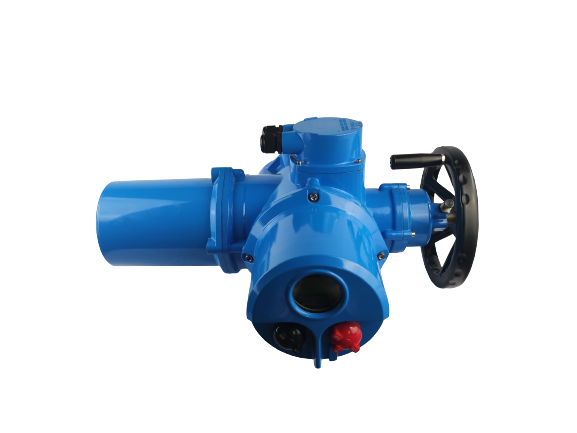

DZW Multi-turn Electric Valve Actuator
Voltage
The power supply voltage of the electric actuator usually has various voltages such as 24V, 48V, 110V, 220V, 230V, 380V, 415V and so on. In addition, the voltage of domestic electric actuators and foreign electric actuators is sometimes different, mainly depending on the main voltage of the country and the specific power supply voltage on site. The main voltages of domestic electric actuators are 220V and 380V. 200V voltage generally has low power, and 380V voltage generally has high power. The speed of the 380V motor is relatively slow, but the torque of the 380V motor is large, and the output force is larger
1. Difference: 380V motors are usually three-phase motors, while 220V motors are usually single-phase motors.
2. Three-phase motor means that when the three-phase stator windings of the motor (each with a phase difference of 120 degrees) are connected to the three-phase alternating current, a rotating magnetic field will be generated, and the rotating magnetic field will cut the rotor winding, thus generating in the rotor winding Induced current (rotor winding is closed path).
3. Single-phase motor generally refers to a low-power single-phase asynchronous motor powered by a single-phase AC power supply (AC220V). This type of motor usually has two-phase windings on the stator and the rotor is of the common squirrel-cage type. The distribution of the two-phase windings on the stator and the different power supply conditions can produce different starting and running characteristics.

What is the control voltage and working voltage of the electric actuator?
The working voltage refers to the voltage of the electric actuator, and the control voltage refers to the application voltage of the auxiliary devices (relays, contactors, etc.) that control the operation of the electric actuator, also known as the secondary line voltage. The control voltage of the electric actuator refers to the voltage that the control system sends control commands to the electric actuator, such as remote opening and closing valve commands, etc., and the working voltage refers to the voltage of the external power supply for the electric actuator.

What is the difference between 24V AC and 24V DC?
1. Different stability: The size and direction of the 24V alternating current change with time; The direction of 24V direct current will not change with time, there is no periodic change, and it is relatively stable.
2. The loss is different: The transmission loss of 24V AC is small, suitable for long-distance transmission; The transmission loss of 24V DC is large, so it is not suitable for long-distance transmission;
3. The magnitude of the voltage drop is different: The value of the voltage drop during the transmission of 24V AC power is large, and the characteristics of easy step-down are just suitable for realizing high-voltage power transmission.

The difference between active electric actuator and passive
Electric devices are generally divided into three types: standard electric head, passive electric head, and intelligent electric device. The standard valve electric device is active, and the switch of the valve is directly controlled by the 220V switch. The passive electric device is under 220V, and the switch of the valve is controlled by the input switch signal. The intelligent electric device is DC12V, which is controlled by a single-chip microcomputer, and has input signals and output feedback signals. The difference between active signal and passive signal: For example, use a switch S to control the coil of a 12VDC relay K, and the contacts of K are marked with 1 and 2 at both ends.
So:
1. The upper end of switch S is connected to 12VDC, and the "signal" output from the lower end is "active signal";
2. The relay K acts, and the 1 and 2 contacts are provided as "signals" to other equipment, that is, the signal output of the "passive signal" (not related to the power supply) source can directly send the feedback signal to the DCS. The signal output of the passive electric actuator needs DCS to provide voltage before it can be used.
Project checklist

Hot Tags: 220v 380v 415v 460v multi-turn electric globe valve actuator, China, manufacturers, suppliers, factory, buy, price, quotation, Electric Valve Actuator, Quarter Turn Valve Actuators, Multi Turn Electric Actuators, Electric Gate Valve Actuator, On Off Type Electric Actuator, High Torque Electric Actuator


