

1. How Electric Actuators Work and Why Global Buyers Need to Understand Their Basic Operating Logic First
The working process of an electric actuator can be summarized as receiving signals, driving the motor, reducing speed to increase torque, actuating the valve, and stopping at the limit. If global buyers treat electric actuators as a black box, they are likely to focus only on price and diameter during selection, neglecting the control method and torque matching. Since site conditions in Russia, South America, the Middle East, and Southeast Asia vary, the performance of electric actuators will also differ. By understanding the basic operating logic, buyers can address key points during inquiries and troubleshooting, and suppliers can more easily provide accurate solutions.
2. Observing how the action command of an electric actuator is transmitted from receiving the control signal to motor start-up
The electric actuator first receives switch signals or analog signals from the control system. A switch signal prompts the electric actuator to perform fully open or fully closed actions, while an analog signal corresponds to a specific opening degree. After the signal enters the control board, the motor power is switched through relays or contactors, causing the motor to start rotating. Some electric actuators also feature signal isolation and anti-interference designs to prevent false operations caused by electromagnetic interference on-site. In parts of the Middle East and Southeast Asia, where on-site power fluctuations are significant, the design of the actuator's power supply terminal and protection circuit directly affects the stability of signal reception.
3. Observing how an electric actuator converts the high-speed rotation of a motor into controllable output torque from speed reduction transmission to valve operation
The motor has a high speed but low torque, so a reduction mechanism is needed to convert high-speed rotation into low-speed, high-torque output. Common internal structures of electric actuators include gear reduction and worm gear mechanisms, and the reduction ratio determines the output torque and operating time. The machining accuracy and lubrication condition of transmission components directly affect the efficiency and service life of the electric actuator. In South American mining areas with heavy dust and vibration, the sealing and wear resistance of transmission components are particularly critical. The high sand and dust environment in the Middle East also accelerates gear wear. If there is a problem in the speed reduction transmission stage, the electric actuator will exhibit weak operation or jamming.
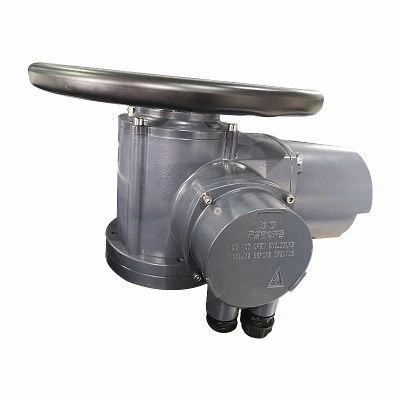
4. How the electric actuator determines when to stop, from limit feedback to stop protection
After the electric actuator reaches the designated position, it needs to stop accurately, which relies on the combined operation of the limit switch and the torque switch. The limit switch is responsible for detecting fully open and fully closed positions, preventing the actuator from exceeding the endpoints and damaging the valve. The torque switch cuts off the motor power when the load abnormally increases, protecting the transmission components. Position feedback signals are also sent back to the control system, allowing operators to know the actual opening of the actuator. High humidity in Southeast Asia can easily cause the limit switch to become damp and fail, while low temperatures in Russia may thicken the grease, leading to an increase in torque; these factors can all affect the accuracy of stop determination.
5. What practical challenges might electric actuators encounter under different working conditions in Russia, South America, the Middle East, and Southeast Asia?
In Russia's extremely cold environment, the viscosity of grease increases during cold starts of electric actuators, leading to higher motor load and potentially extended operation time. In South American mining regions, the medium is highly abrasive, causing increased resistance when the electric actuator drives the valve; insufficient torque margin may lead to overload. In the Middle East, the high temperature and sand-dust environment make heat dissipation difficult, and prolonged operation may trigger overheat protection. In Southeast Asia, the high humidity can cause electrical components to become moist, resulting in possible issues with signal transmission and limit feedback. Buyers should consider the local working conditions when selecting electric actuators, focusing on protection level, lubrication scheme, and torque configuration, rather than applying a uniform standard.
6. What practical benefits can buyers gain in selection and on-site communication after understanding the working principle of electric actuators?
After understanding the working principle of electric actuators, buyers can more accurately specify control methods, torque requirements, and action times during selection, avoiding suppliers guessing based on experience. If abnormal operation occurs on-site, they can also preliminarily determine whether the problem lies in the signal end, motor end, transmission end, or valve end, providing more valuable feedback to the supplier. Buyers in Russia, South America, the Middle East, and Southeast Asia can also propose targeted protection and lubrication requirements based on local operating conditions. Buyers who understand the principles are also clearer about configuration differences when comparing prices, making them less likely to be misled by low prices with low specifications.

7. Summary
Overall, the operation process of an electric actuator includes several stages: receiving signals, starting the motor, deceleration and torque amplification, driving the valve, and stopping at the limit. Each stage has its own corresponding technical points. Differences in operating conditions in Russia, South America, the Middle East, and Southeast Asia can pose different challenges for electric actuators in these stages. When buyers understand the basic operational logic, the processes of selection, communication, and troubleshooting become more efficient. An electric actuator is not a simple switch component, but a transmission control device that needs to match the specific working conditions. Only by understanding how it operates can one make the right choice and use it effectively.
Experience Sharing by Foreign Trade Sales Staff
In the electric actuator export industry, experienced foreign trade sales staff usually advise buyers to take a few minutes to understand the basic working process of electric actuators, as this makes communication much smoother. When customers from Russia, South America, the Middle East, and Southeast Asia describe their requirements, if they can clarify whether the control signal is digital or analog, the torque required by the valve, and the local power conditions, the supplier can more quickly determine which type of electric actuator is suitable. For example, in the high-temperature, sandy environments of the Middle East, attention should be paid to actuator heat dissipation and sealing; in the high humidity environment of Southeast Asia, the electrical components' moisture resistance should be considered; in the extremely cold regions of Russia, the performance of the motor and lubricant during low-temperature startup should be taken into account; and in South American mining areas, the durability of transmission components under dust and vibration conditions should be emphasized. Sales staff generally remind buyers that understanding the entire process of an electric actuator-from receiving the signal to driving the valve and stopping at the limit-helps quickly determine whether a problem arises from the signal side, the motor side, or the valve side when there is a malfunction on site. Knowing a bit of the principle can help communication avoid unnecessary detours.


