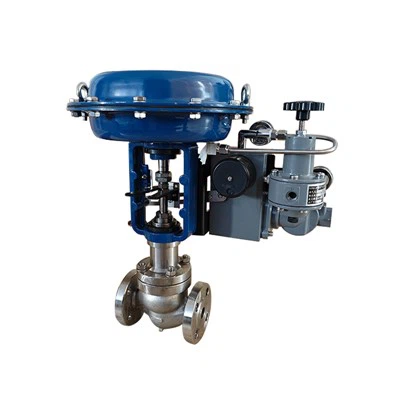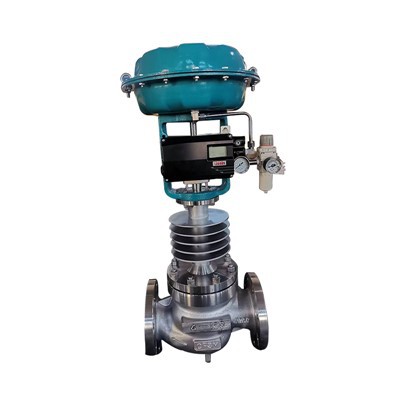


PNEUMATIC CONTROL VALVE POSITIONER

OVERVIEW
Pneumatic control valves are widely used in industrial automation control systems to adjust process parameters such as medium flow, pressure, temperature, liquid level, etc. It is mainly composed of pneumatic actuators and adjustment mechanisms, and uses compressed air as a power source to achieve precise control of the valve.
FEATURES
Simple control
The pneumatic control valve controls the movement of the piston or diaphragm through air pressure, thereby adjusting the opening of the valve disc to control parameters such as medium flow, pressure, and temperature. This control method is relatively simple and easy to operate and maintain.
Intrinsically safe
Since the pneumatic control valve uses compressed air as its power source, no additional explosion-proof measures are required, which makes it more secure.
Quick response
The pneumatic control valve has a fast response speed and can quickly adjust the flow, pressure and other parameters of the medium according to the control signal to ensure the stability and reliability of the production process.

PARAMETERS
Nominal diameter: DN50mm~DN300mm (NPS2~12)
Nominal pressure: PN10MPa~16MPa, PN 1.6, 2.5, 4.0, 6.4Mpa
Temperature range: -29C-300C, etc.

PRECAUTIONS
1. Keep the pipeline clean: Check the control valve connection pipeline for rust, welding slag, dirt, etc. regularly, and remove them in time if found. These dirt will cause wear on the valve core and valve seat of the control valve, affecting the normal operation of the control valve. You can install a filter device such as a filter in front of the control valve and clean it regularly.
2. Check the support of the control valve: The support of the control valve should keep the components of the control valve in a position that is not affected by gravity. If the support is improper, the valve stem and valve seat of the control valve cannot be aligned, the deterioration increases, and the sealing performance decreases.
3. Ensure the quality of the air source: The air source is the energy source for the operation of the control valve. The impurities contained in the compressed air for the instrument will block the throttle hole and the pipeline, causing failures. Therefore, the gas source should be checked regularly to ensure that the gas source quality is good, does not contain water, oil and other debris, and the gas source pressure is stable and meets the requirements.
4. Regular inspection and maintenance: Regularly check whether the valve and pipeline have leakage and blockage problems, and deal with them in time to ensure their normal operation and service life. At the same time, the gear transmission device, actuator and other components should be inspected and maintained to ensure their normal operation.
5. Correct installation and use: When installing the pneumatic control valve, the manufacturer's instructions should be strictly followed to ensure that the valve is installed horizontally, the valve stem is facing upward, and the medium flow direction is indicated by the arrow in the diagram. During use, if any abnormality is found, the machine should be stopped in time for inspection and troubleshooting.
6. Storage and protection: When storing, the pneumatic control valve should be stored in a dry room, and the two ports of the valve must be blocked. Stacking storage is not allowed. The control valve stored for a long time should be checked regularly to remove dirt, and anti-rust oil should be applied to all moving parts and processing surfaces to prevent rust.

PROBLEMS AND SOLUTIONS
1. The control valve does not work
Cause of the problem:
No signal, no air source: the air source valve is not opened, the air source main pipe leaks, the air source contains water and freezes, causing blockage, compressor failure, etc.
There is a air source, but no signal: the regulator fails, the signal tube leaks, the positioner bellows leaks, the regulating mesh diaphragm is damaged, etc.
The positioner has no output: the amplifier constant throttle hole is blocked, moisture accumulates in the compressed air, etc.
Actuator failure: valve stem bending, valve core stuck, etc.
Solution:
Check and repair the air source problem, such as opening the air source valve, repairing the leak, dealing with the icing problem, repairing or replacing the compressor, etc.
Repair or replace the faulty parts, such as the regulator, signal tube, positioner, etc.
Unblock the constant throttle hole, remove dirt or clean the air source to ensure the normal operation of the amplifier.
Remove the valve for further inspection, and repair or replace the actuator parts, such as the valve stem, valve core, etc.
2. Control valve is blocked
Problem causes:
There are sticky substances in the valve body, coking blockage, packing is pressed too tightly, PTFE packing is aged, valve stem is bent and scratched, etc.
Welding slag, rust, etc. in the pipeline cause blockage at the throttle and guide parts.
Solution:
Open and close the bypass or control valve quickly to let the impurities be washed away by the medium from the bypass or control valve.
Install a filter before the control valve to prevent impurities from entering the valve body.
Clean up impurities in the valve body, adjust the tightness of the packing, replace aging packing, etc.
3. Control valve leakage
Problem causes: The valve stem is not suitable for the length, resulting in a gap between the valve core and the valve seat.
There are impurities on the sealing surface of the valve core and the valve seat. Valve internals are worn, corroded or damaged, etc.
Solution:
Adjust the valve stem length to ensure that the valve core and the valve seat are in full contact.
Clean up impurities on the sealing surface of the valve core and the valve seat.
Replace worn, corroded or damaged valve internals.
Fourth, unstable control valve action
Problem causes
Unstable air source pressure: small compressor capacity, pressure reducing valve failure, etc. Unstable signal pressure: inappropriate control system time constant, unstable regulator output, etc.
Solution:
Replace a large-capacity compressor or repair or replace the pressure reducing valve to ensure stable air source pressure. Set the control system parameters or replace the regulator to ensure stable signal pressure.
In summary, for the common problems of pneumatic control valves, it is necessary to carefully check and take corresponding solutions to ensure the normal operation of the valve and extend its service life.
2. Control valve is blocked
Problem causes:
There are sticky substances in the valve body, coking blockage, packing is pressed too tight, PTFE packing is aged, valve stem is bent and scratched, etc.
Welding slag, rust, etc. in the pipeline cause blockage at the throttle and guide parts.
Solution:
Open and close the bypass or control valve quickly to let the impurities be washed away by the medium from the bypass or control valve. Install a filter before the control valve to prevent impurities from entering the valve body. Clean up impurities in the valve body, adjust the tightness of the packing, replace aging packing, etc.
3. Control valve leakage
Problem causes: The valve stem length is not suitable, resulting in a gap between the valve core and the valve seat.
There are impurities on the sealing surface of the valve core and the valve seat.
The valve internals are worn, corroded or damaged.
Solution:
Adjust the valve stem length to ensure that the valve core and the valve seat are fully in contact.
Clean up impurities on the sealing surface of the valve core and the valve seat.
Replace worn, corroded or damaged valve internals.
4. Unstable operation of the control valve
Causes of the problem:
Unstable air source pressure: small compressor capacity, pressure reducing valve failure, etc. Unstable signal pressure: inappropriate control system time constant, unstable regulator output, etc.
Solution:
Replace a large-capacity compressor or repair or replace the pressure reducing valve to ensure stable air source pressure.
Set the control system parameters or replace the regulator to ensure stable signal pressure.
In summary, for common problems of pneumatic control valves, it is necessary to carefully check and take corresponding solutions to ensure the normal operation of the valve and extend its service life.
Hot Tags: pneumatic proportional regulating valve, China, manufacturers, suppliers, factory, buy, price, quotation, Temperature Control Valve, Electric Regulating Valve, Electric Rotary Valve Actuator, 220v Butterfly Valve Electric Actuator, 4 20ma Flow Control Valve, Flange Gate Valve